
Hex bolts are widely used in machinery, steel structures, solar mounting systems, power line hardware and industrial equipment. When purchasing hex bolts, one of the most important specifications to check is the property class, such as 4.8, 8.8 or 10.9.
These numbers indicate the mechanical property requirements of the fastener. They help engineers and buyers understand the bolt's strength characteristics and determine whether it is suitable for a particular application.
However, choosing the right bolt grade involves more than comparing numbers. Buyers also need to consider the applicable standard, bolt dimensions, material, surface treatment and project requirements.
In this guide, we explain the differences between grades 4.8, 8.8 and 10.9, how to identify bolt grades, and what to check before purchasing hex bolts for industrial and engineering projects.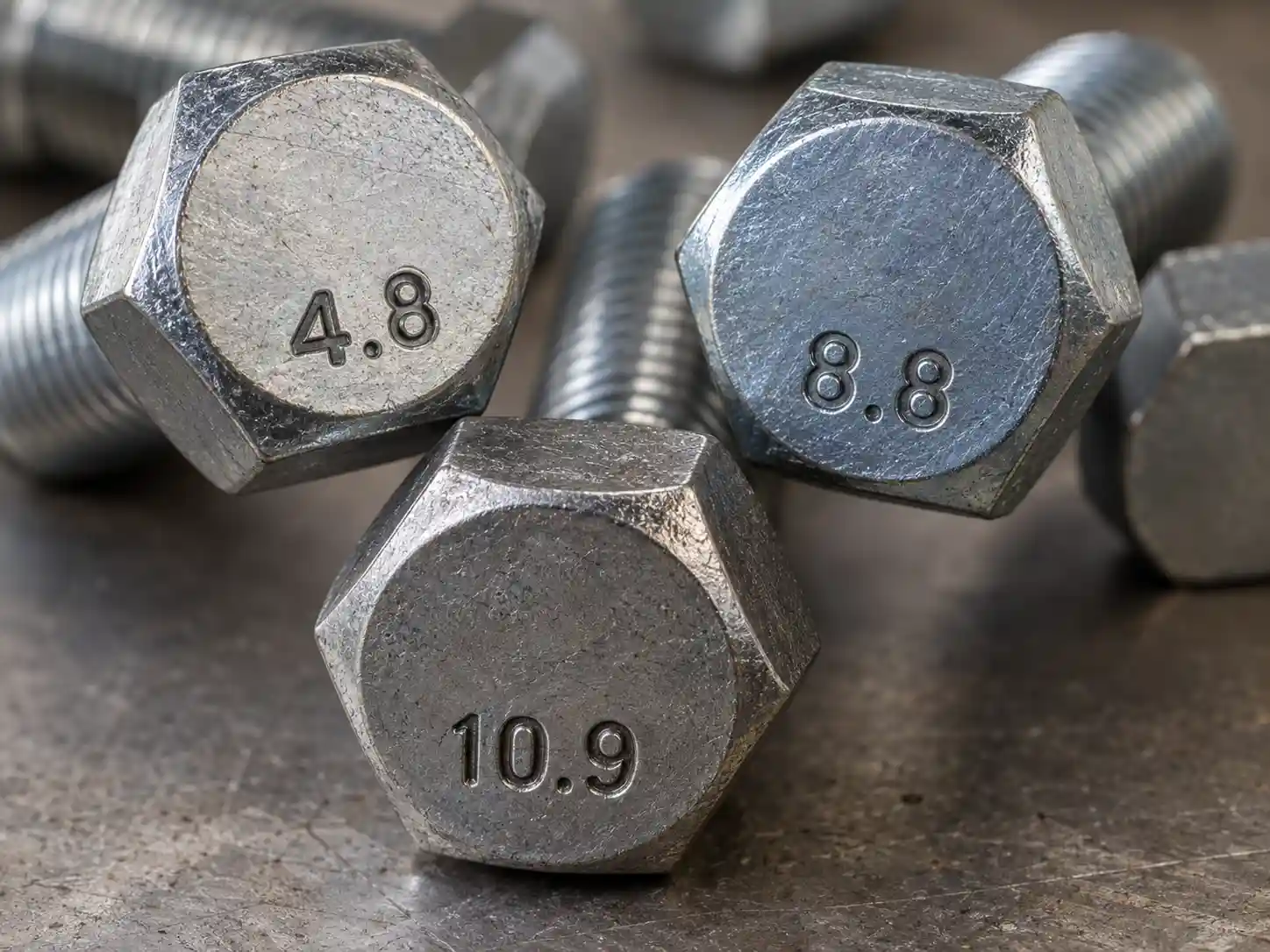
1. What Do Hex Bolt Grades Mean?
For metric carbon steel and alloy steel bolts, screws and studs, ISO 898-1 specifies mechanical and physical properties for different property classes.
Under this standard, the designation system uses two numbers separated by a decimal point. For example, 8.8 is a property class, not a bolt size or surface treatment.
The first number multiplied by 100 indicates the nominal tensile strength in megapascals (MPa). The second number represents one-tenth of the nominal ratio between the yield-related strength and nominal tensile strength.
For example, an 8.8-grade bolt has:
Nominal tensile strength: 8 × 100 = 800 MPa.
Nominal yield-related stress: 8 × 8 × 10 = 640 MPa.
Similarly, a 10.9-grade bolt has a nominal tensile strength of 1,000 MPa and a nominal yield-related stress of 900 MPa.
It is important to understand that these are nominal values used in the designation system. They are not necessarily the minimum values used for product acceptance. Actual requirements must be checked against the applicable standard, bolt diameter and product specification.
2. Grade 4.8 vs 8.8 vs 10.9: Key Differences
The three grades differ in tensile strength, yield-related properties, typical manufacturing requirements and suitable applications.
| Property | Grade 4.8 | Grade 8.8 | Grade 10.9 |
|---|---|---|---|
| Nominal tensile strength | 400 MPa | 800 MPa | 1,000 MPa |
| Nominal yield-related stress | 320 MPa | 640 MPa | 900 MPa |
| Minimum tensile strength under ISO 898-1:2013 | 420 MPa | 800 MPa for d ≤ 16 mm; 830 MPa for d > 16 mm | 1,040 MPa |
| Typical strength category | Lower strength | High strength | Higher strength |
| Typical production approach | Often cold-formed without quenching and tempering | Generally quenched and tempered | Generally quenched and tempered |
| Common application direction | General fastening | Machinery and engineering connections | Higher-strength mechanical connections |
Note: The table summarizes selected requirements under ISO 898-1:2013. The minimum tensile strength for 8.8 depends on nominal diameter. Structural bolting and products covered by other standards may have different requirements. The nominal yield-related value for 4.8 should not be interpreted as a directly comparable minimum yield-strength acceptance value.
Grade 4.8 Hex Bolts
Grade 4.8 bolts are used in general fastening applications where the required mechanical performance is lower than that of high-strength grades.
Typical applications include general equipment assembly, ordinary brackets and non-critical mechanical connections where the design permits this property class.
Grade 4.8 does not mean poor quality. A bolt is acceptable when it meets the required dimensional, material and mechanical specifications for its intended use.
However, grade 4.8 should not replace a higher-strength bolt when the engineering drawing or design specification requires grade 8.8 or 10.9.
Grade 8.8 Hex Bolts
Grade 8.8 is a widely used high-strength property class for metric bolts. It is commonly specified for machinery, industrial equipment and various engineering connections.
These bolts generally require suitable steel and heat treatment, commonly quenching and tempering, to achieve the required mechanical properties.
Grade 8.8 bolts may be used in solar mounting structures, steel structures and industrial assemblies when the engineering design specifies this grade.
For buyers, it is important to confirm the complete specification rather than simply requesting an 8.8 bolt. Diameter, length, thread pitch, surface treatment and the required product standard must also match the application.
Grade 10.9 Hex Bolts
Grade 10.9 bolts provide higher nominal strength than grade 8.8 bolts. They are commonly used in demanding mechanical and industrial connections where the design requires higher mechanical performance.
Producing compliant 10.9 bolts generally requires suitable steel, controlled heat treatment and careful quality inspection.
Because high-strength fasteners have specific mechanical and installation requirements, buyers should not automatically substitute grade 10.9 for grade 8.8. The correct grade must be determined by the engineering design, connection requirements and applicable standard.
3. How Much Stronger Is a Higher Bolt Grade?
Bolt grade affects the stress that the fastener can withstand, but the actual tensile load also depends on the bolt's tensile stress area.
Consider an M12 coarse-thread bolt with a nominal tensile stress area of approximately 84.3 mm².
Using the minimum tensile strengths specified by ISO 898-1:2013, the corresponding minimum tensile loads are approximately:
| Grade | Minimum tensile strength | Minimum tensile load for M12 |
|---|---|---|
| 4.8 | 420 MPa | 35.4 kN |
| 8.8 | 800 MPa | 67.4 kN |
| 10.9 | 1,040 MPa | 87.7 kN |
These figures illustrate why bolt grade matters even when the dimensions are identical.
However, minimum tensile load is not the same as allowable working load. Actual design capacity depends on factors such as joint configuration, loading direction, fatigue, thread engagement, installation method and the applicable safety requirements.
For this reason, engineering projects should use the specified design criteria rather than selecting bolts from tensile strength alone.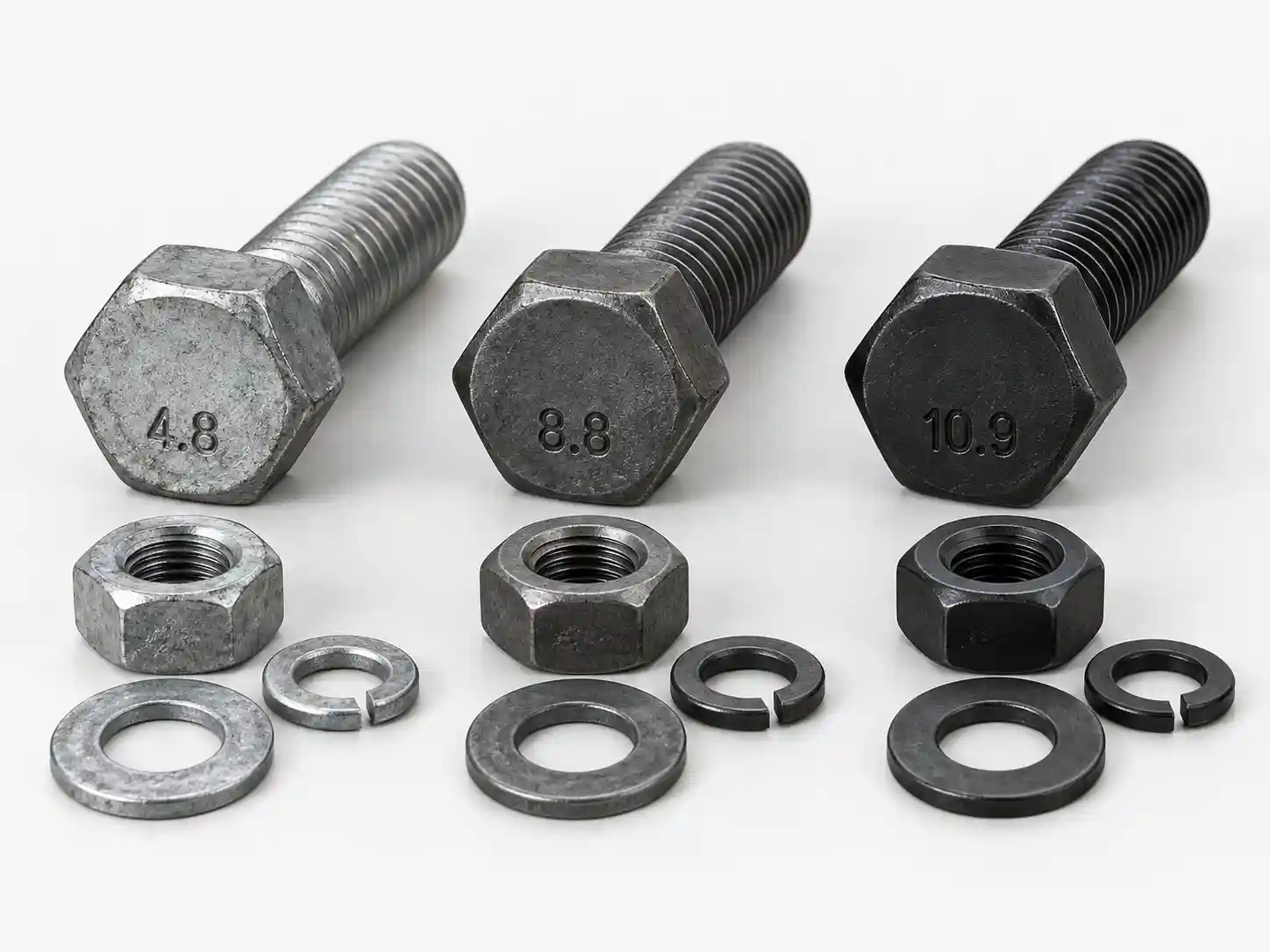
4. How to Identify Hex Bolt Grades
Identifying a bolt grade is important when receiving goods, inspecting stock or checking whether a supplier has delivered the correct product.
Check the Head Marking
Metric hex bolts may carry markings such as 4.8, 8.8 or 10.9 on the bolt head. A manufacturer's identification mark may also be present.
Under ISO 898-1, marking requirements depend on the applicable product and marking provisions. For many full-loadability bolts with nominal diameters of 5 mm and above, property-class and manufacturer identification markings are required.
During inspection, check that:
The property-class marking is legible.
The manufacturer's identification mark is consistent with the supplied documentation.
The marking matches the purchase order and packaging label.
Products within the same batch have consistent identification.
Head markings are useful for initial identification, but they do not independently prove that the bolt meets all mechanical requirements.
Check the Material and Quality Documents
For commercial and engineering orders, buyers should request the relevant material and inspection documents.
Depending on the order requirements, these may include a material test certificate, mechanical test report, certificate of conformity and batch traceability records.
The documents should identify the correct product, grade, dimensions and inspection batch. A report stating that a product is grade 10.9 is not sufficient if it cannot be linked to the actual delivered batch.
Perform Hardness Testing
Hardness testing is commonly used as part of fastener quality control. Methods include Rockwell, Vickers and Brinell hardness testing.
Hardness measurements can help identify material or heat-treatment problems. However, hardness alone cannot establish that a bolt complies with every requirement for its property class.
The result must be evaluated using the applicable standard, test method, measurement location and acceptance limits.
Conduct Mechanical Testing
Tensile testing and proof-load testing are important methods for verifying bolt performance.
A tensile test evaluates the bolt's response to increasing tensile force and can establish relevant mechanical properties. A proof-load test checks whether the fastener withstands the specified test load according to the applicable acceptance criteria.
For important engineering orders, batch-based inspection should be carried out according to the agreed test plan and relevant standard.
Chemical analysis may also be useful for checking material composition, but it cannot independently confirm the final mechanical performance of a finished bolt.
5. How to Choose the Right Hex Bolt Grade
The correct bolt grade depends on the application and engineering requirements, not simply on which grade has the highest strength.
Before purchasing hex bolts, consider the following factors:
Application and loading: Determine whether the bolt will be used for general assembly, machinery, steel structures or another load-bearing connection.
Bolt dimensions: Confirm diameter, length, thread pitch and the required tensile stress area.
Applicable standard: Identify whether the project requires ISO, DIN, ASTM or another specific standard. Similar-looking grades under different standards should not be assumed to be interchangeable.
Material and manufacturing requirements: Confirm the required material and mechanical properties, especially for higher-strength grades.
Surface treatment: Specify hot-dip galvanizing, zinc plating or another finish according to the project requirements. Strength grade and corrosion resistance are different properties.
Inspection requirements: Confirm whether the order requires hardness tests, tensile tests, proof-load tests, material certificates or other documents.
For solar mounting systems, power line hardware and outdoor steel structures, fasteners must satisfy both mechanical and environmental requirements. The selected grade should follow the approved drawing or engineering specification.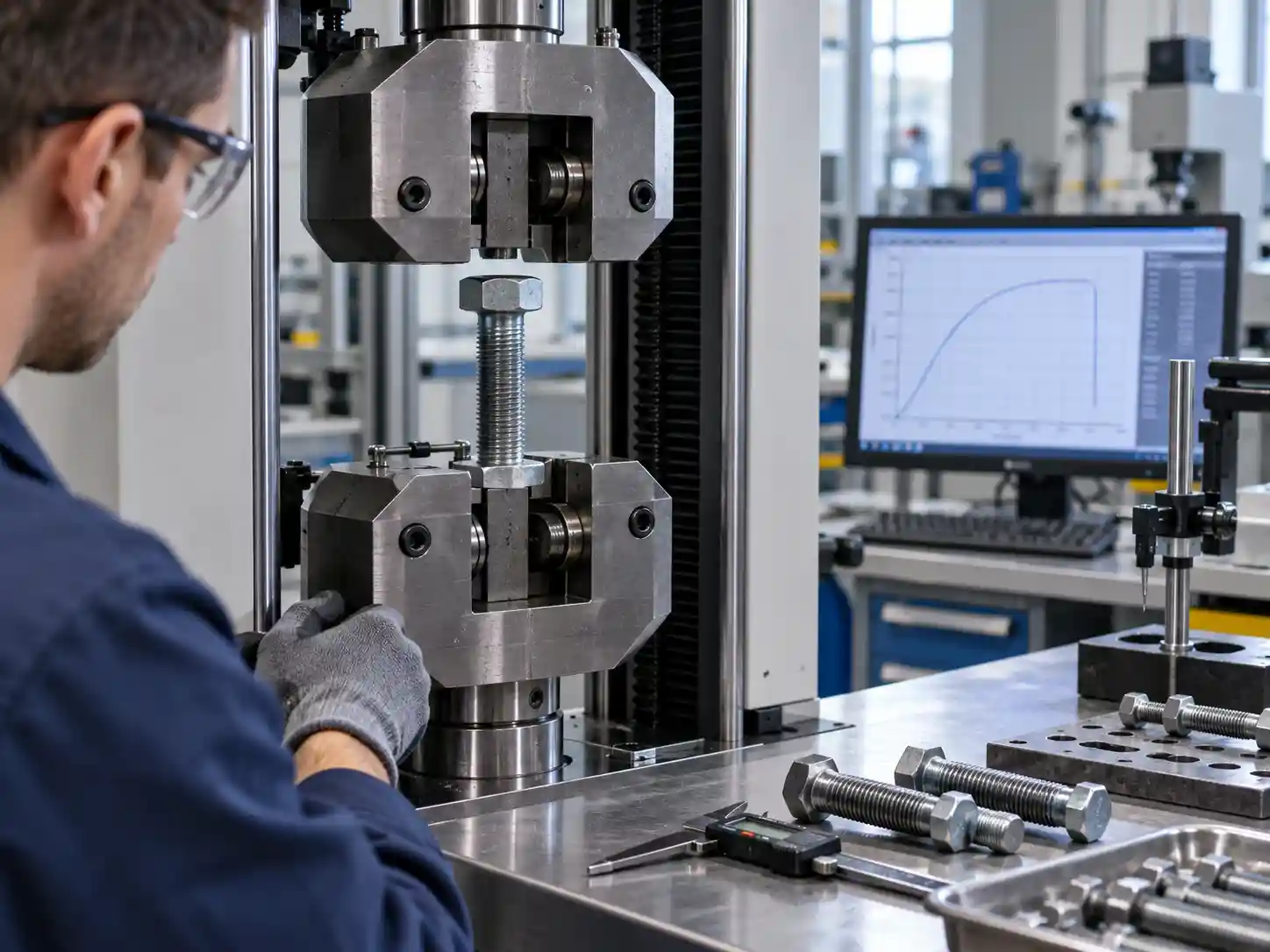
6. Common Mistakes When Purchasing Hex Bolts
Several common mistakes can lead to incorrect orders or quality problems.
Choosing a bolt by appearance alone. Bolts with similar dimensions may have different property classes. Visual inspection cannot verify all mechanical properties.
Assuming higher strength is always better. A higher grade is not automatically suitable for every connection. Design requirements and installation conditions must be considered.
Confusing strength grade with surface treatment. An 8.8-grade bolt is not necessarily more corrosion-resistant than a 4.8-grade bolt. Corrosion protection depends on material, coating and environmental conditions.
Ignoring the applicable standard. ISO metric property classes and ASTM product specifications use different designation systems and requirements. Confirm the complete specification before ordering.
Failing to verify batch traceability. Test reports and material certificates should correspond to the actual supplied products.
Avoiding these mistakes helps buyers improve purchasing accuracy, reduce inspection risks and maintain consistent product quality.
Conclusion
Hex bolt grades 4.8, 8.8 and 10.9 represent different mechanical property requirements. Grade 4.8 is commonly used for general fastening, grade 8.8 is widely used for high-strength engineering connections, and grade 10.9 is selected for applications requiring higher strength.
The correct choice depends on the engineering design, bolt dimensions, applicable standard, material, surface treatment and inspection requirements.
Kangnaigu supplies hex bolts, nuts, washers, galvanized fasteners and related fastening products for industrial and engineering applications. We support product selection according to customer specifications and project requirements.
If you are sourcing hex bolts for machinery, solar mounting systems or steel structure projects, send us your required grade, dimensions, surface treatment and quantity. Our team can help confirm the specifications and provide a quotation for your project.
Frequently Asked Questions
What is the difference between grade 8.8 and grade 10.9 bolts?
Grade 10.9 has higher nominal tensile strength and higher minimum tensile-strength requirements than grade 8.8. However, the appropriate grade depends on the engineering design and applicable product standard.
How can I identify an 8.8-grade hex bolt?
Check the head marking and manufacturer identification, then verify the product documentation. For critical applications, use appropriate mechanical testing to confirm compliance.
Does a higher bolt grade mean better corrosion resistance?
No. Mechanical strength and corrosion resistance are different properties. Corrosion resistance depends on the material, surface treatment and service environment.
Can I replace a grade 8.8 bolt with a grade 10.9 bolt?
Not automatically. The substitution must be reviewed against the engineering design, connection requirements, installation method and applicable standard.
What information should I provide when requesting a hex bolt quotation?
Provide the required standard, property class, diameter, length, thread specification, material, surface treatment, quantity and any drawings or inspection requirements. This information helps the supplier quote the correct product.
Technical References
ISO 898-1:2013 — Mechanical properties of fasteners made of carbon steel and alloy steel
EN ISO 898-1:2013 — Mechanical properties of screws and studs, technical property tables
Always verify the standard edition and product requirements specified in the purchase order or engineering drawing.